

Přístroj je vyroben z tmavě mořené a čiré lakované mosazi. Přístroj má dva spektroskopy s přímým pozorováním, které lze kombinovat a vytvořit spektroskop s větší refrakční silou. Přístroj je určen pro použití na středně velkých refraktorech; za účelem určení polohy pozorování lze rotaci odečítat na disku v krocích po 1° přes celý kruh. Pozorovací štěrbiny jsou variabilní a na boku je také připevněno zařízení, které odráží srovnávací spektrum. Polohy spektrálních čar lze odečítat mikrometrem s jemným hrotem.
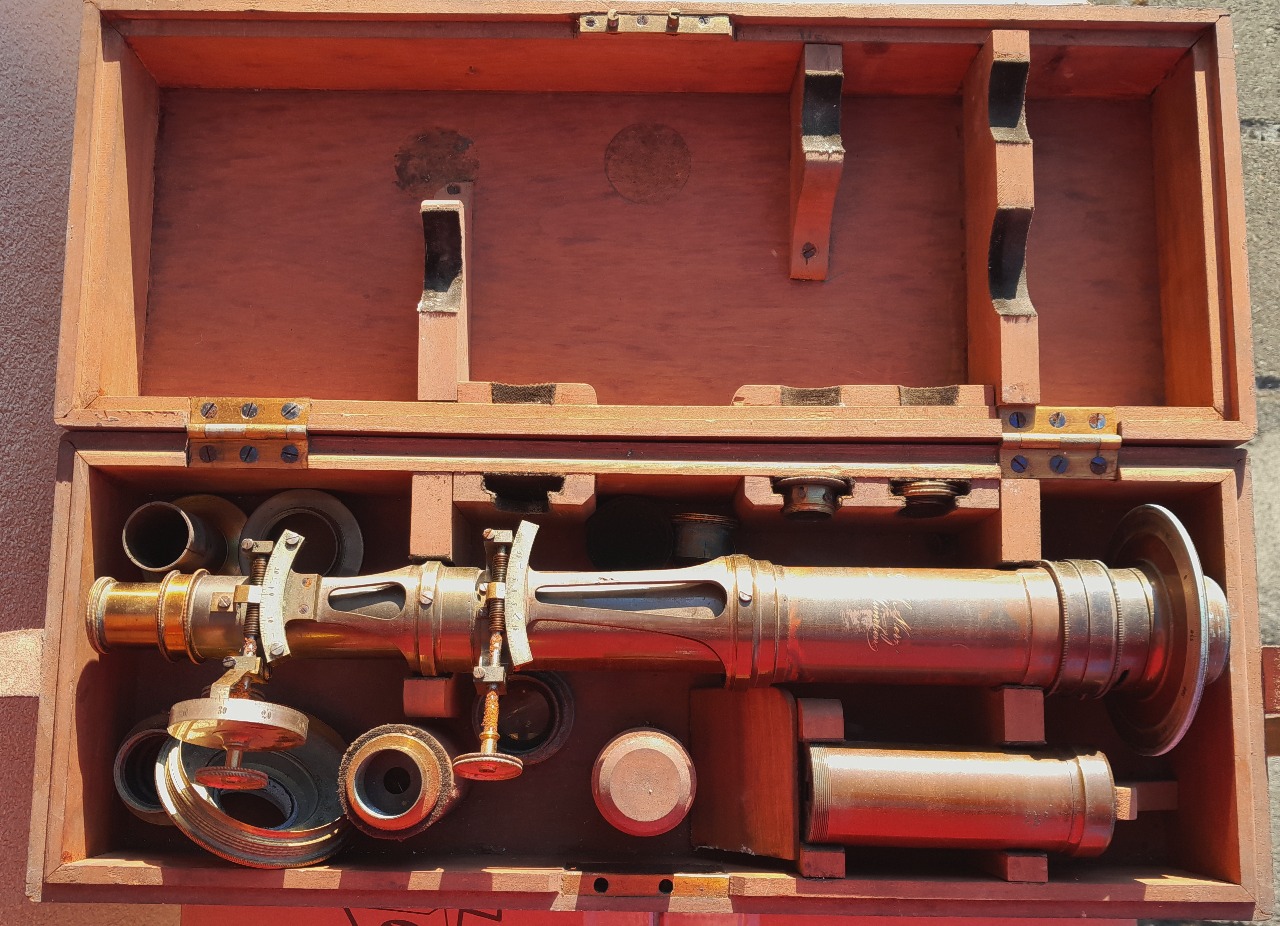
Skládá se z jednoduchého a složeného spektroskopu s přímým viděním, které se částečně doplňují. První přístroj má hranol s přímým viděním s rozptylovou mohutností DH = 8° a kladný okulár ekvivalentní ohniskové vzdálenosti 1" spolu s cylindrickou čočkou. Kombinovaný přístroj má stejný spektrální hranol, štěrbinu, kolimátor a pozorovací dalekohled. Objektivy druhého mají stejnou ohniskovou vzdálenost a mají 7" mikroskop s ohniskem s horním ohniskem 4" s pozitivním dalekohledem. 1″ okulár a je vybaven nezbytným jemným nastavením.
Štěrbina má potřebné korekce, za ní odrazový hranol pro srovnání plamene a cylindrická kolektivní čočka. Toto sestavené zařízení je ještě vybaveno malým pozičním kotoučem. Spektrální hranol lze nyní odšroubovat z jednoduchého zařízení a vložit jej mezi kolimátor a spektrální hranol složeného zařízení, čímž se zdvojnásobí disperze spektroskopu a přístroj se stane vhodným pro pozorování slunečních protuberancí. K tomuto účelu je také sloupek navržen tak, aby se dal dostatečně otevřít. K přístroji jsou dodávány i sluneční brýle a všechny díly jsou obsaženy v elegantním pouzdře. Cena 120 tolarů. = 210 fl.
Dr. Francisovi. FLS atd.
Mnichov, listopad 1870
Pane,
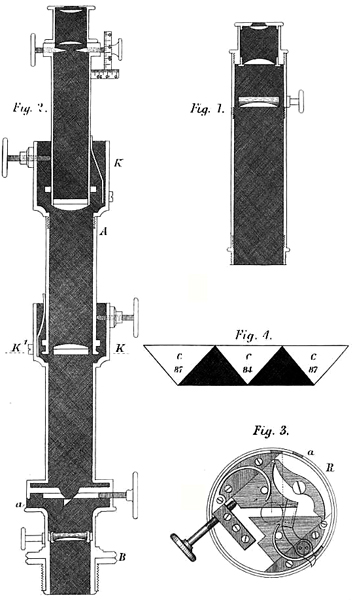
In Carl’s Repertorium der Physik, vol. vi. p. 273, there is contained the description of a small universal star-spectroscope constructed by me, accompanied by an explanatory Plate. As, however, since that article appeared this compendious little instrument has been improved in various essential particulars, at the suggestion of a friend I make bold to forward to you a short description thereof, and also a corrected sketch of its arrangement. The instrument consists of two principal parts, or, in other words, of two spectroscopes, each of which may be used singly, and which are in part complementary to each other. The one part, which is a simple direct-vision spectroscope, is provided with a prism of novel construction. This prism consists of five elements, two of which are of flint glass, each having a refracting-angle of 84°; the other three prisms are of crown glass; one of them has also a refracting-angle of 84°, the other two of 87°, as shown in Plate II.fig. 4. This portion of the apparatus is furnished with a positive eyepiece with an equivalent focal length of 1 inch, and it is also provided with a cylindrical lens of 1 inch radius. The arrangement of this portion of the apparatus is shown in fig. 1.
The compound spectroscope, which is represented in fig. 2, is provided with a similar spectral prism. It has a tube furnished with a slit, and a collimator, and likewise an observing-telescope. The object-glasses of the latter and of the collimator are of the same focal length, namely 4 inches; their aperture is 2/3 of an inch.
The observing telescope carries, moreover, a needle-micrometer with an eyepiece of 1/2-inch focal length. It is also provided with two red sun-glasses, which admit of being used either singly or together. This compound spectroscope is moreover furnished with a small divided position-circle situated at B.
The spectral prism can be unscrewed from the simple apparatus (fig. 1) and inserted at A, between the observing -telescope and the spectral prism of the compound apparatus (fig. 2), whereby the dispersion of the spectroscope is doubled, and the entire instrument rendered available for the observation of the solar protuberances.
mehr anzeigen
Zdroj: https://www.musoptin.com